

In Albania, love is inventive to infinity

ONE of the first things I noticed when myself and my colleague Andrea entered the Vincentian Fathers' House in Grudë e Re—and briefly escaped the searing heat of an Albania summer—was a simple fledgling house plant, tied to two broom handles to assist its growth. It was an image that made me realise that this place is somewhere that is rooted in love, care and support and it’s an image that leans into the famous phrase uttered by St Vincent De Paul himself, ‘love is inventive to infinity.’
The love, care and support provided by the Vincentian Fathers should come as no surprise to us here in Scotland though, because the SSVP, which has had a presence in most of our parishes, has been a strong witness to that for nearly 200 years. From a personal perspective, when my gran experienced some hard times during the 1950s and 60s, the SSVP were there for her and my family. The fact that I was only made aware of this after her passing is indicative of the focus that they place on respecting a person’s dignity.
It’s not a pre-requisite, but it certainly helps when working with people experiencing all kinds of different hardships, if you’ve encountered trials and tribulations yourself, and priests and religious sisters in Albania can certainly attest to that. The country lived under a brutal and oppressive Communist regime for nearly five decades and, as a result, Catholicism—and other religions—suffered tremendously and was forced underground.
Thirty-seven men and one woman were martyred for their Faith and were subsequently Beatified by Pope Francis in 2016. Masses were celebrated in secret, Catholics spoke in hushed tones about their Faith so as not to attract the attention of the Sigurimi (Albania’s secret police) and churches were converted into cinemas and sports halls in an attempt to preserve them for future generations. It was a fight for survival, but survive the Faith did, thanks to the courageous Catholic men and women of Albania and the country is all the better for it.

Help and healing
However, despite the fall of Communism in 1991, the scars of living under such a regime are visible even today and present many challenges for the Vincentian Fathers working in Albania.
Historical trauma is one such issue. For example, successive governments have proven to be corrupt, but many—admittedly older—people were so conditioned not to challenge authority that this corruption has largely gone unchecked. Moreover, as a coping mechanism for dealing with such trauma, many people have unfortunately fallen into drug addiction. Into the vacuum too have come organised crime gangs—in effect an Albanian mafia working closely with their more famous Italian counterparts—who constantly recruit young people into their ranks to traffic drugs and even people. Violence, including domestic violence, may not have risen, because—under Communist rule stability was prioritised over safety—but it is certainly more evident. Emigration, since the 1990s has happened year-on-year, leading to some family members both feeling—and literally being—abandoned. In turn, this has led to issues of poverty and homelessness.
People’s trust in authority—and even in each other—is low, but one area where the trust has grown is between Albanians and the Catholic Church. Priests like Fr Agustin Margjoni—the Superior of the Vincentians in the country and the first ever National Director of the Pontifical Mission Societies in Albania—have proven themselves to the people. In spite of the many challenges that he faces in his missionary work, he remains undeterred.
“Here in Albania, the Vincentian Fathers have always worked with the poor and on the peripheries—the places where perhaps others would prefer not to go,” he said. “This is a true mission territory on the outskirts of Shkodër. This is exactly where we want to be. Wherever we find people with the greatest need, that is where we believe Christ is calling us to be.
“Together, we try and live a simple life alongside the people. We work with the elderly, families, children, the sick and the poor. We want to accompany people, to be with them, to share in their lives and to support all those who have been abandoned.”
Listening to Fr Augustin and also seeing their work in action reminded me very much of Matthew’s Gospel passage (Matthew 25:35-6), in which Jesus says: “For I was hungry and you gave me food, I was thirsty and you gave me drink, I was a stranger and you made me welcome, I was naked and you clothed me, sick and you visited me, in prison and you came to see me.”
This is evident in the project that Missio Scotland is supporting in nearby Vinotekë, a men’s refuge run by the Vincentian Fathers. While there has been some improvement in the past two decades in social policies supporting many of the country’s disadvantaged groups, this is sadly not the case for men in difficulty—an issue that is prevalent in many other countries throughout the world. The Vincentians, however, have stepped into that breach by firstly opening up their house to men who have been abandoned and former prisoners who have nowhere else to go.
“Over the past few years we have welcomed several men into our house,” Fr Augustin explained. “Some have found housing and started a new life, some have reconciled with their families and sadly one or two have returned to prison because they made bad choices.”

A life less ordinary
It was in prison that fellow Vincentian, Fr Luigi Cannato, encountered Maximillian Fushë, a bright, intelligent, young man of 26, full of potential, who had fallen on hard times. When you hear his story, it’s not hard to understand why.
Before he was born, Max’s grandmother on his mother’s side was murdered by his grandfather. This was not only something she witnessed, but something she had warned her mother of the night before, having heard her father sharpening the knife he used to kill her mother. Her heartbreak didn’t end in childhood though, as when she was older, her brother and sisters left her to start a new life in Italy. In spite of that, she met and fell in love with Max’s father and they started their own family with Max and his elder brother. Max’s father’s family were never happy with the arrangement though, because he was from an affluent family, while his mother came from a more humble background. His father's extended family did their best to break Max’s family up and eventually succeeded when his father abandoned them.
After that, Max, his brother and his mother were practically homeless. The three of them lived together in an orphanage, in a semi-legal squat, in Red Cross accommodation, in abandoned train carriages and in parks where his mother would put cardboard down on the ground in winter as basic protection from the snow. Naturally, despite being highly intelligent, his education suffered. He left school early to try and be the head of the family, but the burden of that responsibility took its toll. He fell in with a bad crowd and, like his brother, he developed a drug addiction. Driven by a desire that exists to this day to make his mother proud—even to the extent of going on national television—Max overcame this affliction. However, her death in 2024 saw him relapse and after a violent altercation with his brother, he found himself in prison. This is where Fr Luigi and the Vincentians came in.
“I met Fr Luigi for the first time in prison,” Max recalled in perfect English. “He was so kind to me and he said ‘you can come and stay with us,’ He was so kind to me. He trusted in me. He saw more in me than I did in myself. Day-by-day he helped me get better. He’s such a kind soul.
“I am free of drugs and I am getting better. I have returned to God. I am working on having a better relationship with myself and with God going forward.”
Thanks to the work of the Vincentians, Max is now envisaging a better future for himself, one in which he has a family, gives back to others and—as previously mentioned—makes his mother proud. The love Max had and still has for his mother is also inventive to infinity.
“My mum was basically my idol,” Max said. “My childhood was about trying to make her proud. She was my understanding of love, sacrifice and everything. If I could have had one gift as a child it would have been to see her happy and not crying anymore.
“I remember when I was eight years old, I came home from school and overheard her in the kitchen asking my brother how they would feed me. So, I took my bike, sold it for €10 and bought food with it. I told my mother I had crashed my bike and someone who saw me crying had given me the money to compensate me. I never told her the truth, because I didn’t want her to feel bad.
“You can’t change your childhood, regardless of how bad it was, but I am very positive for the future and I’m still determined to make her proud.”
Tide has turned
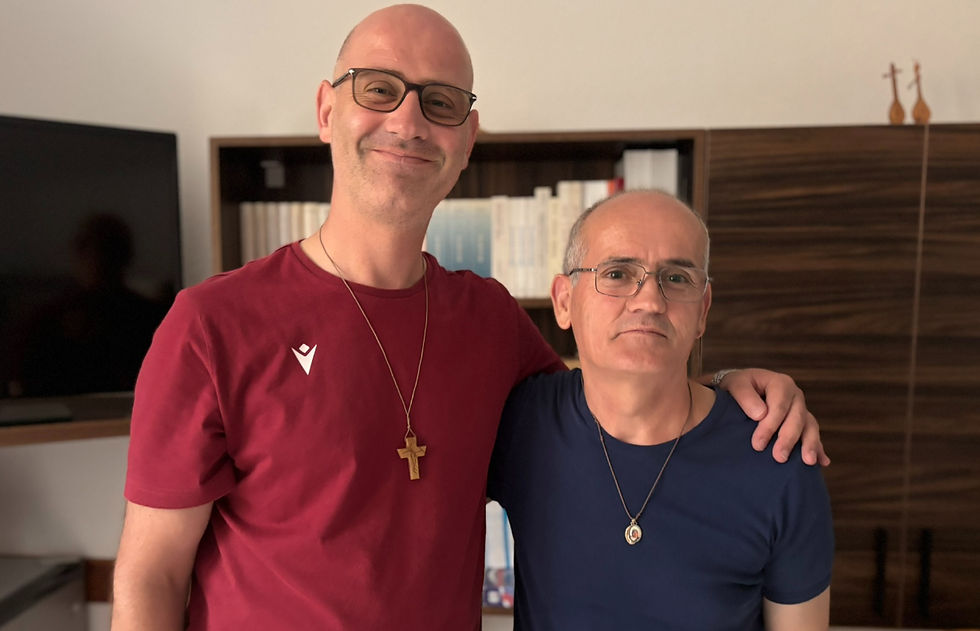
Another person who can look forward with hope to a future full of positivity thanks to the intervention of the Vincentians is 56-year-old Kastriot Fushë—no relation to Max. Often found performing handyman duties in and around the church and the Vincentians’ House, Kastriot arrived there with a similarly tragic tale to tell. His family suffered great persecution during the Communist regime. One of his family members was a seminarian who was killed by the regime outright, another, a priest, died in prison. Kastriot’s family surname was even changed by the authorities.
In his family home, Kastriot himself, fared little better. He was a twin who was not wanted by his mother and father, was barely tolerated under their roof and was subjected to regular violent abuse from his father—the scars of which can still be seen today. In spite of all this, Kastriot married and had a daughter called Mihajla. Family life for him was happy until one day it all came crashing down.
He and his wife divorced, she left with her brothers for Italy and he was made homeless. A Vincentian priest named Fr Gjergj Ndreka found Kastriot living on the streets of Mamurras in Central Albania. After staying with him for a while, Fr Agustin contacted him and told him to send Kastriot to their house where there was more room. Since moving in with the Vincentian Fathers, his life is flourishing once again and he is back in contact with his daughter and his new grand-daughter.
“For a while she didn’t come to see me because she felt guilty and ashamed about how I was treated,” Kastriot explained. “But now I have a very good relationship with her and she makes me so happy. She’s so intelligent and very beautiful. I go and see her every month.
“That’s all down to the stability of living with the fathers. I live very well here. They have helped me so much in the last four years and I thank God for everything I have received through them.
“The Church has always helped me, be it through the Franciscans, the Vincentians or others who have come into my life. God has helped me through His people. So, my faith is very important to me. Nothing is more important than God.
“To the people of Scotland who are supporting the work of the Church here, I say God bless you. I love you very much and I will pray for you. Thank you for everything.”

God's grace in action
While the two men are currently living in the Vincentians' House, they, and several others will be housed at this brand new men’s refuge in Vinotekë (above), which boasts more space for the men to live and, if they so choose, to work. It will also be staffed by healthcare professionals who will be on hand to deal with trauma and other related mental health issues. Missio Scotland is proud to be supporting this project that will assist a plethora of men who pass through its doors and, in turn, Fr Agustin has echoed the warm words of Kastriot for this much-needed assistance in getting the men’s refuge up and running.
“For us, this support is truly a grace from God,” Fr Agustin enthused. “It feels like the hand of God reaching out to us. At exactly the moment when we need to begin this work, help has arrived. Knowing that people in Scotland are thinking about us and standing beside us as we try to serve the poorest people gives us enormous encouragement.
“The Church is one family. That is exactly what this partnership shows. Those who have a little more are helping those who have a little less. That is how the Church should be. For Scotland to work closely to with us in order to help the poor here in Albania means a great deal. This collaboration is deep and meaningful. We are sincerely grateful and I will pray for all of you. God bless you.”
Why not like us on Facebook: http://www.facebook.com/missioscotland, and follow us on Twitter: @Missio_Scotland, Instagram: MissioScotland and Bluesky: @missioscotland.bsky.social
To donate to Missio Scotland, visit: https://www.missioscotland.com/donate call us on: 01236 449774 or send donations to: Missio Scotland, St. Andrews, 4 Laird Street, Coatbridge ML5 3LJ
You can also now donate to us via text. Text MISSIOSCOT to 70085 to donate £3 or MISSIOSCOT with any number between 1-20 after it to donate your desired amount (For example MISSIOSCOT 10 will donate £10). Thank You


Comments